Beyond the Search Bar: Why Hyper-Personalization is the Heart of Business in 2026
The marketing landscape of 2026 has officially moved past the “experimental” phase of AI. We are now in a trillion-dollar digital advertising ecosystem where the traditional tools of the trade—static funnels and generic segmentation—have become relics of the past. For businesses looking to thrive today, digital marketing is no longer just a department; it is the fundamental infrastructure for growth.
The 2026 Mandate: Why Digital is Non-Negotiable
In 2026, your customers aren’t finding you through a single search box. We have entered the “Search Everywhere” era. Traditional search engine volume has dropped by an estimated 25% as users migrate to AI chatbots, virtual agents, and social discovery platforms like TikTok and Instagram.
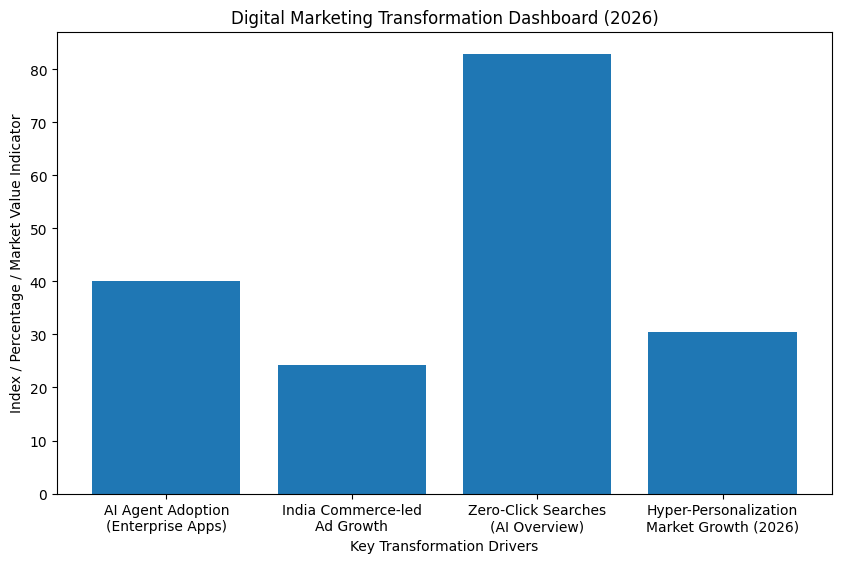
Furthermore, “zero-click” searches where the user gets their answer directly from an AI overview without ever visiting a website now account for nearly 60% of US searches and 70% of EU searches.
What is Hyper-Personalization?
Hyper-personalization is the evolution of marketing from “segment-based” to “individual-based.” While traditional personalization might use a customer’s name or purchase history to send a generic email, hyper-personalization uses real-time data, AI, and predictive analytics to adapt to a customer’s intent in the exact moment of engagement.
It factors in:
-
Real-time behavior: What the user is clicking on right now.
-
Contextual signals: Their current location, the time of day, and even local weather patterns.
-
Predictive intent: Using machine learning to anticipate what a customer will need before they even search for it.
How It Helps Your Business
Implementing hyper-personalization isn’t just about “being cool”—it’s a massive ROI engine.
-
Explosive Conversion Rates: Personalized campaigns in 2026 are seeing conversion rate lifts of over 20%.
When a customer feels a brand truly “gets” them, the path to purchase is much shorter. -
Increased Marketing Efficiency: AI-driven personalization can reduce customer acquisition costs (CAC) by up to 50% and increase overall marketing ROI by 10-30%.
-
Terminal Loyalty: In a world of infinite choice, hyper-personalization creates a “switching cost.” Once a customer experiences a journey tailored perfectly to their needs—like Spotify’s predictive playlists or Amazon’s anticipatory shipping—switching to a competitor feels like starting over from scratch.
-
Faster Sales Cycles: By removing friction and providing the exact right content at the right time, businesses are seeing significantly shorter buying cycles, especially in complex B2B environments.
The Regional Edge: The Indian Context
India has become a global digital-first leader with over 1.03 billion internet users.
Trust and the Privacy Paradox
The power of hyper-personalization comes with a responsibility to maintain trust. With the full applicability of the EU AI Act as of August 2026 and India’s Digital Personal Data Protection (DPDP) Act, transparency is mandatory.
Consumers in 2026 are highly skeptical of “creepy” tracking; 78% of users say explicit labeling of AI content is essential for maintaining trust.
The Bottom Line
Digital marketing in 2026 is about building intelligent systems, not just running ads. By embracing hyper-personalization, you move from being a source of noise to being a source of genuine, proactive value. In the Intelligence Era, the brands that win aren’t the ones who scream the loudest, but the ones who listen the best